






In the world of comedy, few names shine as brightly as Jim Carrey and Andy Kaufman. While each built a legacy based on unique styles of humor, their stories became deeply intertwined in a way that both fascinated and disturbed fans. The connection between them reached a peak during the production of Man on the Moon (1999), a film based on the life of Kaufman, with Carrey taking on the leading role. The transformation was more than just an act—it was a psychological journey that revealed both the genius and the risks involved in method acting.
Understanding Andy Kaufman’s Unorthodox Genius
Andy Kaufman was not a typical comedian. Unlike performers who focused on jokes or traditional setups, Kaufman specialized in performance art that pushed the boundaries of comedy. Audiences were often unsure whether what they were seeing was real or a well-crafted illusion. His portrayal of foreign characters, his infamous wrestling matches with women, and even his alter ego, Tony Clifton, were all parts of an elaborate act that blurred reality and fiction.
Kaufman’s commitment to confusing and captivating audiences earned him a cult following, but also criticism. Some considered him a comedic genius; others found him frustratingly strange. He never clarified whether his antics were genuine or part of a long-running joke. His death in 1984 at the age of 35 added a final twist—some still believe it was another elaborate hoax.

Jim Carrey’s Rise and the Role That Changed Him
By the time Man on the Moon was in development, Jim Carrey had already cemented himself as a Hollywood megastar. Known for his elastic facial expressions, physical comedy, and memorable roles in films like Ace Ventura, The Mask, and Liar Liar, Carrey had shown both comedic brilliance and emotional depth in films such as The Truman Show. But the opportunity to portray Kaufman was something else—it was a challenge, a tribute, and a transformation.
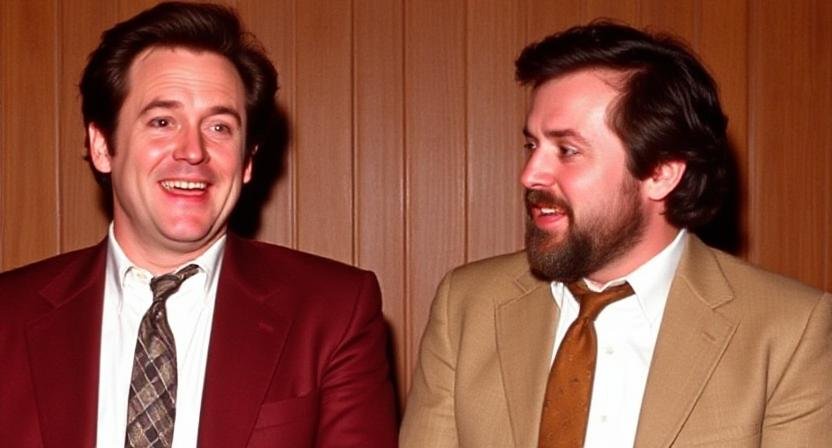
Carrey did not merely act as Kaufman. He immersed himself so deeply into the role that he refused to break character even when the cameras weren’t rolling. On set, he acted as Kaufman in real life, speaking, dressing, and behaving exactly as Kaufman might. Friends, colleagues, and even Kaufman’s real-life family members interacted with Carrey as if he were Andy. This level of method acting pushed boundaries, raising questions about identity, mental health, and the emotional cost of art. andy kaufman jim carrey
Behind the Scenes: Chaos and Creation
The behind-the-scenes turmoil during the making of Man on the Moon is well documented, especially in the 2017 documentary Jim & Andy: The Great Beyond. In it, viewers get a rare glimpse into how far Carrey went to embody Kaufman. The footage, which had been hidden for nearly two decades, shows a chaotic set where Carrey, in character, frustrated directors, angered co-stars, and even brought people to tears.
Carrey’s dedication was undeniable, but it also became controversial. Director Milos Forman struggled with Carrey’s refusal to break character, while other actors found the environment emotionally draining. Still, the final product earned critical praise, and Carrey won a Golden Globe for his performance. Many argued that only someone as wild and bold as Carrey could have captured Kaufman’s essence so accurately.
Yet, the experience left a lasting impact. Carrey has said that during filming, he lost his sense of self. He felt as though Andy had taken over, guiding his thoughts and decisions. This idea—the blurring of lines between actor and character—adds another layer to the mysterious connection between Jim Carrey and Andy Kaufman.
The Impact on Carrey’s Career and Identity
After Man on the Moon, Carrey’s career took a more introspective turn. He began to explore philosophical and spiritual ideas, often speaking in interviews about consciousness, ego, and the nature of reality. Many fans and critics believe that his time spent portraying Kaufman sparked this shift. The experience forced him to confront questions about identity and performance—both on-screen and off.
He later admitted that the transformation had been both liberating and terrifying. “At some point,” Carrey said, “I realized I didn’t exist.” This wasn’t just acting—it was a full-body experience of inhabiting someone else’s life, mind, and soul. The connection between Jim Carrey and Andy Kaufman became more than artistic—it became existential.
Carrey stepped back from the limelight in the years following, focusing on painting, philosophy, and selective film projects. In many ways, his encounter with Kaufman’s life and spirit left a permanent mark. It wasn’t just a role—it was a mirror that reflected the depth of both men’s eccentricity and brilliance.
Fans’ Reactions and Cultural Legacy
The portrayal of Kaufman by Carrey sparked intense reactions. Some fans were amazed by how accurately Carrey captured Kaufman’s energy, unpredictability, and charm. Others were disturbed by the psychological toll it appeared to take. The documentary Jim & Andy added fuel to the discussion, showcasing moments that were both fascinating and unsettling.
What united most reactions, however, was a deep appreciation for the raw commitment involved. The story of Jim Carrey and Andy Kaufman speaks to the heart of what it means to be an artist. It raises questions about authenticity, transformation, and the emotional risks involved in fully becoming someone else.
Kaufman himself might have appreciated the chaos and confusion. After all, he was a master of uncertainty, and Carrey’s portrayal added yet another chapter to his mystique. The fact that some still speculate whether Kaufman is alive today only reinforces the strange loop of reality and illusion both men seemed to dance through.
Psychological Implications of Method Acting
Method acting has always drawn both admiration and caution. Actors like Daniel Day-Lewis and Heath Ledger also dove deep into characters with consequences both brilliant and tragic. In the case of Jim Carrey and Andy Kaufman, the situation was even more complex, as Kaufman himself was a performer who constantly tested identity.
For Carrey, embodying Kaufman meant more than just wearing a costume or memorizing lines. It meant channeling the energy, unpredictability, and contradictions of a man who refused to be understood. Carrey found himself caught in Kaufman’s world—one where fiction and reality blended dangerously close.
Psychologists have weighed in on the impact of such immersion, noting that prolonged identity displacement can lead to dissociation, emotional fatigue, or even crisis. Carrey’s post-film interviews reflect these possibilities, as he often spoke of losing himself and questioning the very nature of who he was.
Artistic Courage or Psychological Risk?
The debate continues: Was Carrey’s transformation a brave artistic achievement or a dangerous psychological gamble? Perhaps it was both. Few actors have committed so entirely to becoming another person, and fewer still have done so when the person in question was as enigmatic as Andy Kaufman.
The partnership—or collision—between Jim Carrey and Andy Kaufman is now legendary in film and comedy circles. It stands as an example of how art can push boundaries, not just creatively but personally. The price of authenticity, it seems, can sometimes be higher than anyone anticipates.
Still, the performance remains one of Carrey’s most powerful and unforgettable. For fans of both artists, the film represents a rare fusion of talent, madness, and meaning—an artistic gamble that continues to echo decades later.
Conclusion: The Eternal Echo
The story of Jim Carrey and Andy Kaufman is a strange, beautiful, and at times haunting exploration of identity and performance. Through Man on the Moon, Carrey gave life once more to a man who had made it his mission to challenge what people believed was possible in comedy and art.
Their connection endures—not just in cinema, but in the way it has influenced how we think about acting, legacy, and the human psyche. In many ways, Andy Kaufman’s spirit lives on through Carrey’s haunting and heroic portrayal. And in doing so, it reminds us that the line between performer and performance, between reality and illusion, is thinner than we think.